PU Prime App Review 2026: Mobile Trading Guide
Last updated: August 2026. Spread and fee figures sourced from puprime.com/account-types/ and puprime.com/spread-and-costs/. All values are subject to change — verify current figures on those pages...
Reviewed using our forex & CFD broker review methodology
Last updated: August 2026. Spread and fee figures sourced from puprime.com/account-types/ and puprime.com/spread-and-costs/. All values are subject to change — verify current figures on those pages before trading.
Disclosure: This page may contain affiliate links. We may earn a commission if you open an account through our links, at no extra cost to you.
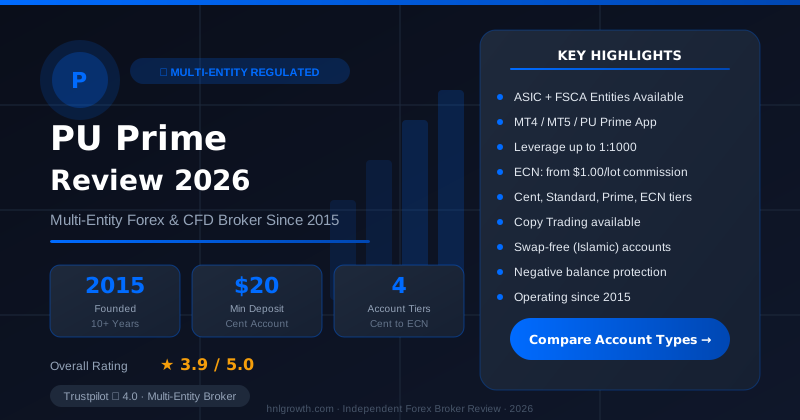
PU Prime is a multi-entity CFD broker operating since 2015 that provides mobile trading across MT4, MT5, and a proprietary PU Prime app. Whether the platform is right for you depends less on the app's features and more on which legal entity covers your account. Traders onboarded under ASIC (AFSL 410681) sit under tier-1 regulation with stronger client protections; most international traders are assigned to the FSA Seychelles or FSC Mauritius entities, which carry materially lower investor protections. Identify your entity first — then evaluate the rest.
Quick Verdict: Right Fit or Not?
PU Prime's mobile offering suits active traders assigned to the ASIC or FSCA entity, comfortable with MT4/MT5 execution, and interested in copy-trading access alongside standard CFD instruments.
It is a poorer fit if:
- You are based in the UK or another country where FCA authorisation is required. The FCA does not authorise PU Prime — check the FCA register at fca.org.uk for current status — and no FSCS protection applies.
- You require a tier-1 statutory investor compensation scheme as a baseline condition.
- You are not comfortable with offshore entity terms (FSA Seychelles, FSC Mauritius) and their limited external dispute recourse.
- Your strategy depends on independently verified execution metrics — slippage and latency figures for PU Prime's mobile app are not available in publicly accessible sources.
Geographic Restrictions
PU Prime explicitly restricts access for residents of the Philippines, as noted on its homepage. Other jurisdictions may also be restricted under local regulatory requirements. If you are unsure whether the service is available in your country, contact PU Prime support before attempting to open an account. Traders in restricted regions will be declined during registration.
Which Entity Covers You — The Jurisdiction Map
This is the most consequential section in this review. PU Prime operates through multiple legal entities, and the protections you receive depend entirely on which entity your account is assigned to. The broker's regulation page lists its licences but does not always make clear which entity applies to which trader location.
Table 1: Jurisdiction-to-entity mapping
| Trader location | PU Prime entity | Regulator | Regulator tier | Key note |
|---|---|---|---|---|
| Australia | PT Prime Global Markets Pty Ltd | ASIC (AFSL 410681) | Tier 1 | Strongest client protections; verify at ASIC Connect (asic.gov.au) |
| South Africa | PU Prime (Pty) Ltd | FSCA (FSP 52218) | Tier 2 | Meaningful oversight; verify at fsca.co.za |
| UAE | PU Prime (UAE) LLC | CMA (Licence 20200000388) | Tier 2 | Verify current licence status at the UAE CMA public register |
| Most international | PU Prime Limited | FSA Seychelles (SD050) | Tier 3 — offshore | Lower formal client protections; limited external recourse |
| Some international | Prime Capital Group Limited | FSC Mauritius (GB23202672) | Tier 3 — offshore | Lower formal client protections |
| UK residents | No authorised entity | FCA — not authorised | N/A — check FCA register | FCA does not authorise PU Prime; no FSCS protection applies |
Verification: Check ASIC Connect (asic.gov.au), the FSCA FSP register (fsca.co.za), FSA Seychelles (fsaseychelles.sc), FSC Mauritius (fscmauritius.org), the UAE CMA public register, and the FCA register (fca.org.uk) for current licence status. Regulatory status can change.
Regulation and Client Protections by Entity
Table 2: Entity protection comparison
| Entity | Regulator | Segregated accounts | Negative balance protection | Investor compensation scheme | Complaint escalation |
|---|---|---|---|---|---|
| ASIC (AU) | ASIC AFSL 410681 | Required by ASIC rules | Applies per ASIC requirements for retail clients | No government FSCS-style scheme; AFCA membership — confirm directly on the ASIC licence record before relying on this path | ASIC; AFCA if PU Prime holds AFCA membership — verify before opening an account |
| FSCA (ZA) | FSCA FSP 52218 | Required by FSCA | Applies per FSCA requirements | No FSCS equivalent | FSCA complaint division |
| CMA (UAE) | CMA Lic. 20200000388 | Required by CMA | Per CMA requirements | Verify with UAE CMA | UAE CMA |
| FSA Seychelles | FSA SD050 | Required by FSA rules | Policy states it applies — verify in entity-specific terms | No government compensation scheme | FSA Seychelles (complaints@fsaseychelles.sc); no independent ombudsman with binding authority |
| FSC Mauritius | FSC GB23202672 | Required by FSC rules | Policy states it applies — verify in entity-specific terms | No government compensation scheme | FSC Mauritius; limited external escalation |
The practical difference between tier-1 and offshore entities is complaint escalation. An ASIC-regulated client in Australia may be able to escalate unresolved disputes to AFCA, an independent financial ombudsman — but this path depends on PU Prime holding current AFCA membership, which you should confirm directly on the ASIC licence record before relying on it. A client on the FSA Seychelles entity has the FSA's internal complaint process but no equivalent independent ombudsman with binding authority over the broker. This is a material limitation, not a technicality.
PU Prime's website states that client funds benefit from Lloyd's insurance coverage up to $1,000,000. This is separate from regulatory compensation schemes. The scope, exclusions, and precise conditions of this coverage are not detailed in the publicly available pages reviewed for this article. Verify the full policy terms directly with PU Prime before treating this coverage as equivalent to a statutory investor compensation scheme.
Account Types and Cost Fit
Table 3: Account type matrix — Figures from puprime.com/account-types/, August 2026. Spreads are variable; verify current values before trading.
| Account | Min. deposit | Spread from (indicative) | Commission per lot (round turn) | Max leverage (offshore entity) | Best for |
|---|---|---|---|---|---|
| Cent | $20 | From 1.3 pips | None | Up to 1:1000 | Strategy testing, small-capital live exposure |
| Standard | $50 | From 1.3 pips | None | Up to 1:1000 | Everyday traders, commission-free simplicity |
| Prime | $1,000 | From 0.0 pips | $7.00 ($3.50 per side) | Up to 1:1000 | Active traders wanting tighter spreads |
| ECN | $10,000 | From 0.0 pips | $2.00 ($1.00 per side) | Up to 1:1000 | High-volume traders, lowest per-trade cost |
The leverage figures in the table apply to offshore entity accounts. ASIC-regulated retail accounts are subject to leverage limits mandated by ASIC — the applicable limits for different instrument classes are published on ASIC's website (asic.gov.au). Confirm the leverage applicable to your specific entity and account type before trading.
Table 4: Worked cost scenario — 1 lot EUR/USD, illustrative only. Based on August 2026 indicative spread data; actual spreads are variable. Swap rates vary by instrument, direction, and market conditions — check live rates in MT4/MT5 under the instrument specification, or in the PU Prime app, before trading.
| Account | Spread cost (1 lot, illustrative) | Commission (round turn) | Overnight swap | Indicative total (ex-swap) |
|---|---|---|---|---|
| Standard | ~$13.00 (1.3 pip) | $0 | Variable — check in-platform | ~$13 |
| Prime | ~$0–$3.00 (0.0–0.3 pip) | $7.00 | Variable — check in-platform | ~$7–$10 |
| ECN | ~$0–$3.00 (0.0–0.3 pip) | $2.00 | Variable — check in-platform | ~$2–$5 |
Note that spreads widen during low-liquidity periods (such as around market open/close and major news events), so the indicative low-end figures above will not reflect real costs in volatile conditions. The ECN account's lower per-lot commission becomes cost-effective only at high trading volumes — the $10,000 minimum deposit sets a high practical bar. For most active traders, the Prime account ($1,000 minimum) offers a better cost-to-entry balance.
Frequently Asked Questions
Is PU Prime regulated? Yes — under ASIC (AFSL 410681), FSCA (FSP 52218), FSA Seychelles (SD050), FSC Mauritius (GB23202672), and CMA UAE (Licence 20200000388). The protections you receive depend on which entity your account is assigned to. ASIC provides the strongest protections for retail clients; FSA Seychelles and FSC Mauritius provide materially lower client protections.
Is PU Prime authorised in the UK? No. The FCA does not authorise PU Prime. UK-based traders should check the current FCA register and any warning notices at fca.org.uk before opening an account.
What is the minimum deposit? $20 for the Cent account; $50 for Standard; $1,000 for Prime; $10,000 for ECN. Confirmed at puprime.com/account-types/.
How long do withdrawals take? Official timelines: cards 3–5 business days; e-wallets instant to same day; bank transfers 1–5 business days. The first IBT withdrawal is free; subsequent IBT withdrawals cost $20. These are officially stated ranges; real-world processing times are not independently verified.
Does the PU Prime app support automated trading? MT4 and MT5 mobile apps allow monitoring and management of open positions, but EA execution requires a persistent desktop instance or VPS. The proprietary PU Prime app does not run EAs.
What leverage is available? Up to 1:1000 is listed for offshore entity accounts. ASIC-regulated retail accounts are subject to lower leverage limits mandated by ASIC — the applicable limits by instrument class are published at asic.gov.au. Confirm the leverage applicable to your specific entity before trading.
Can I copy trade on mobile? Yes — PU Prime's copy-trading feature (PU Social) is accessible through the proprietary PU Prime app. According to PU Prime's copy-trading documentation, the minimum allocation is $25 per signal provider. Copy trading carries its own risks: your results depend on the signal provider's performance, and past performance does not indicate future results.
Does an inactivity fee apply? Not confirmed or ruled out in official sources reviewed for this article. Contact PU Prime support or review your account's terms of service to confirm.
Is PU Prime available in the Philippines? No — PU Prime's homepage states that its products and services are currently unavailable to residents and entities in the Philippines.
Risk warning: CFDs and leveraged forex products are complex instruments and carry a high risk of losing money rapidly due to leverage. Consider whether you understand how these products work and whether you can afford to take the high risk of losing your capital. Check the entity, terms, and protections that apply in your jurisdiction before trading.
Ready to Compare PU Prime Account Types?
PU Prime is a multi-entity broker — ASIC (Australia) and FSCA (South Africa) regulated entities offer stronger oversight, while most international clients are onboarded to the FSA Seychelles or FSC Mauritius entities. Four account tiers (Cent, Standard, Prime, ECN) range from a $20 minimum deposit to full ECN pricing.
Risk disclaimer: PU Prime is a live, regulated multi-entity broker — trading forex and CFDs is done with real capital under normal market risk (this is not a simulated prop-firm evaluation). PU Prime operates under multiple separate licenses (ASIC, FSCA, FSA Seychelles, FSC Mauritius); which entity holds your account depends on your country of residence and determines your leverage cap and protections — confirm this before funding. CFDs and leveraged forex products are complex instruments and carry a high risk of losing money rapidly due to leverage; 62.2% of retail investor accounts lose money when trading CFDs with this provider. Consider whether you understand how CFDs/forex work and whether you can afford the high risk of losing your money. Affiliate disclosure: HNL Growth earns a commission when you open a PU Prime account through links on this page.