Vantage Spreads & Fees 2026: Raw vs Standard
Vantage's Raw ECN spreads run from 0.0 pips plus $3/lot commission; Standard STP has no commission but wider spreads. Compare all-in costs.
Reviewed using our forex & CFD broker review methodology
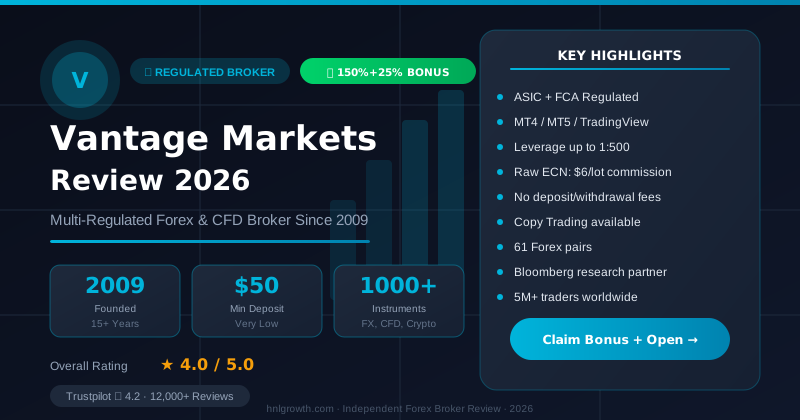
If you're pricing out Vantage before funding an account, the number that matters isn't the headline "from" spread — it's the all-in cost per round trip once commission is added. Vantage prices its Standard STP account through the spread alone (from 1.0 pips, no commission) and its Raw ECN account through a tighter spread (from 0.0 pips on majors) plus a $3.00 per lot, per-side commission ($6.00 round turn). A third tier, Pro ECN ($1.50/lot/side, $10,000 minimum deposit on Vantage's global entity), targets professional traders and money managers trading larger volumes; Vantage's UK entity offers a separate equivalent called Premium ECN ($0.75/lot/side, $25,000 minimum) instead. Which one is cheaper depends on your pair, lot size, and trade frequency — not on which number looks smaller in an ad.
This guide breaks down the spread model, the commission math, and the costs that don't show up on the pricing page, so you can compare account types on the metric that actually affects your P&L.
Spread model overview
Vantage runs two distinct pricing mechanics rather than one universal spread:
- Standard STP routes orders through Vantage's liquidity network with the cost built into the bid/ask spread. There's no separate commission line item — you pay the spread and nothing else.
- Raw ECN (and Pro ECN) passes through tighter, closer-to-interbank pricing and charges a commission on top. The spread compresses, but you're now paying two cost components instead of one.
Vantage's own spreads page states spreads starting from 0.0 pips for Raw ECN accounts and from 1.0 pips for Standard STP accounts, and notes that major pairs can trade under 1 pip "during high-liquidity periods." That last phrase matters for a day trader: "from" and "starting at" describe the tightest observed condition, not a guaranteed average. Spreads on any STP/ECN broker widen around low-liquidity windows (Asian session, pre-London open) and around scheduled news, and Vantage doesn't publish a fixed floor that applies at all times. Treat published figures as a reference point for best-case pricing, then confirm the live quote on your platform before sizing a trade.
Raw vs Standard spreads (and where Pro ECN fits)
Vantage's accounts page frames the three core tiers by trader profile rather than by a single spec sheet: Standard STP for novice traders looking for direct market access with no commissions; Raw ECN for experienced traders seeking razor-sharp spreads, low commissions, and deep liquidity; and Pro ECN for professional traders and money managers who trade large volumes. A fourth option — described as suitable for "any level" — removes swap charges for traders whose religious beliefs prohibit paying or receiving overnight interest.
| Account | Execution model | Spread (from) | Commission | Minimum deposit | Best fit |
|---|---|---|---|---|---|
| Standard STP | STP, no commission | 1.0 pips | None | $50 | Traders who want one line-item pricing, lower trade frequency |
| Raw ECN | ECN, commission-based | 0.0 pips on majors | $3.00/lot/side ($6.00 round turn) | $50 | Active/high-frequency traders optimizing all-in cost |
| Pro ECN (global/offshore entity) | ECN, commission-based | From 0.0 pips | $1.50/lot/side ($3.00 round turn) | $10,000 | Professional traders and money managers trading large volumes |
| Premium ECN (UK FCA entity only) | ECN, commission-based | From 0.0 pips | $0.75/lot/side | $25,000 | High-volume traders opened under Vantage's UK entity |
| Swap-free (any tier) | Matches underlying account | Matches underlying account | Matches underlying account | Matches underlying account | Traders who cannot pay/receive swap for religious reasons |
Sources: Trading Accounts, Spreads, Standard STP vs Raw ECN help article, PRO ECN account, Premium ECN account (UK).
Vantage's own help center summarizes the practical distinction: Raw ECN suits short-term or high-frequency traders who benefit from tighter spreads despite paying commission, while Standard STP suits traders who prefer a simpler, single-cost structure without tracking a separate commission line.
Important: Pro ECN and Premium ECN are two different accounts, not two names for one account. Vantage's global/offshore entity offers Pro ECN at $1.50 per lot per side commission with a $10,000 minimum deposit (confirmed via Vantage's APAC help center and its own Pro ECN account page). Vantage's UK FCA-regulated entity (Vantage Global Prime LLP) does not offer Pro ECN at all — its live account lineup is Standard STP, Raw ECN, Premium ECN, and Spread Betting, per its own account-types article. Premium ECN charges $0.75 per lot per side with a $25,000 minimum deposit — a lower per-lot commission but a much higher deposit than Pro ECN. Which one applies to you depends entirely on which Vantage entity you're onboarded to, which is generally determined by your country of residence — confirm this before assuming either figure applies to your account.
Separately, Raw ECN's commission also varies by entity: Vantage's global/APAC materials cite $3.00 per lot per side ($6.00 round turn — the figure used throughout this guide), while Vantage's UK entity publishes a lower rate of "from $1.00 per lot per side" on its own commission fees page. If you're trading through the UK entity, verify which rate applies to your account rather than assuming the global figure.
Disclosure: This page may contain affiliate links. We may earn a commission if you open an account through our links, at no extra cost to you.
Commission structure
The commission model only applies to Raw ECN and Pro ECN. Standard STP has none — its entire cost sits in the spread.
For Raw ECN, Vantage's accounts page states the commission as $3.00 per standard lot, per side, which equals $6.00 round turn (open and close). That's the figure to use when calculating all-in cost, not the spread alone.
For Pro ECN (global/offshore entity), Vantage's APAC help center and its own Pro ECN account page state a commission of $1.50 per lot per side ($3.00 round turn) — half of Raw ECN's per-side rate, with a $10,000 minimum deposit. For Premium ECN (UK FCA entity's equivalent top-tier account — not the same product, see note above), the UK help center states $0.75 per lot per side, with a $25,000 minimum deposit. Since these figures differ by entity and the entity you're onboarded to depends on your country of residence, confirm which account and rate applies to you directly with Vantage before assuming either figure.
Converting commission to a pip-equivalent cost. For a USD-quoted major like EUR/USD, one standard lot (100,000 units) has a pip value of roughly $10. A $6.00 round-turn commission is therefore roughly equivalent to 0.6 pips of added cost. That conversion is what lets you compare a "spread-only" account against a "spread-plus-commission" account on the same scale — comparing headline spreads alone (1.0 pips vs 0.0 pips) without adding commission back in understates the Raw ECN account's true cost.
For JPY-quoted pairs, the pip value per standard lot moves with the exchange rate (it isn't a fixed $10), so the commission's pip-equivalent will shift slightly pair to pair. The dollar cost of the commission itself doesn't change — only how many pips it represents does.
Typical asset examples
Vantage's spreads page publishes example pricing for four major pairs, shown separately for Standard STP and Raw ECN accounts:
| Pair | Standard STP spread (example) | Raw ECN spread (example) | Raw ECN commission (round turn) | Raw ECN all-in cost (approx.) | Standard STP all-in cost |
|---|---|---|---|---|---|
| EUR/USD | from 1.4 pips | from 0.0 pips | $6.00 (~0.6 pips) | ~0.6 pips | from 1.4 pips |
| GBP/USD | from 1.6 pips | from 0.5 pips | $6.00 (~0.6 pips) | ~1.1 pips | from 1.6 pips |
| AUD/USD | from 1.4 pips | from 0.3 pips | $6.00 (~0.6 pips) | ~0.9 pips | from 1.4 pips |
| USD/JPY | from 1.5 pips | from 0.4 pips | $6.00 (~0.6–0.9 pips)* | ~1.0–1.3 pips* | from 1.5 pips |
*Commission-to-pip conversion for USD/JPY depends on the prevailing exchange rate since pip value per standard lot isn't fixed at $10 the way it is for the other three pairs.
Source: Vantage Spreads page. These are example figures published on Vantage's own site at the time of research, not live quotes — spreads move constantly with liquidity, and Vantage itself frames "from" pricing as achievable "during high-liquidity periods" rather than as a fixed rate. Check the live spread on your platform before entering a trade, particularly around session opens/closes and scheduled data releases.
On this example set, Raw ECN comes out cheaper on an all-in basis for every pair shown, which is the pattern you'd expect from an ECN-plus-commission model competing against a wider no-commission spread. The gap narrows as the Raw ECN spread widens (GBP/USD and USD/JPY show a smaller advantage than EUR/USD), so the "which account is cheaper" answer isn't uniform across your pair mix — it's worth running this math for the specific pairs you actually trade.
For instruments outside the four majors Vantage lists on its spreads page — gold (XAUUSD), indices, share CFDs, cryptocurrencies — Vantage's published spread pages reviewed for this guide do not provide specific spread figures. Vantage's account documentation confirms these are available as CFDs across over 60 forex pairs plus indices, commodities, share CFDs, ETFs, and cryptocurrencies on MT4, MT5, and the Vantage App, but pricing on gold and indices in particular is typically far more liquidity-dependent than majors. If XAUUSD cost is central to your strategy, check the live spread on a demo or funded account rather than relying on any published "from" figure for a non-FX instrument.
Other trading and non-trading fees
Beyond spread and commission, a few cost lines are worth checking before you fund an account:
- Swaps (overnight financing). Any leveraged position held past the daily rollover cutoff incurs a swap charge or credit, depending on the interest rate differential between the two currencies and your position direction. Vantage's published pages reviewed for this guide do not include a swap rate table. Swap rates move with central bank rates and broker markups. Check the live rate in your platform's contract specification window before holding a position overnight, especially over a weekend triple-swap day.
- Swap-free option. Vantage offers a swap-free structure for traders whose religious beliefs prohibit paying or receiving interest, described on the accounts page as available at "any level." If this applies to you, confirm eligibility and whether it's layered on top of Standard, Raw, or Pro pricing.
- Account opening. Vantage states there's no charge to open any of its trading accounts; minimum deposit requirements apply instead, with $50 cited as the amount you can start with.
- Deposit and withdrawal processing. Method-specific fees and currency conversion costs can apply depending on how you fund the account and which currency your account is denominated in. These aren't detailed in the general fee pages referenced here, so confirm current terms for your chosen payment method before transferring funds.
- Inactivity. Some brokers apply a dormancy fee after a period of no trading activity. This wasn't confirmed in Vantage's published account or fee pages reviewed for this article — check your account terms directly rather than assuming either way.
How costs compare
Rather than benchmark Vantage against named competitors using numbers we can't independently verify at the time of writing, it's more useful to know how to read any broker's cost structure the same way:
- Never compare a spread-only account against a spread-plus-commission account on spread alone. A 0.0 pip headline is only "free" if you ignore the commission sitting behind it. Convert commission to a pip-equivalent (dollar commission ÷ pip value per lot) and add it to the spread before comparing.
- "From" figures describe the best case, not the average. Every broker's marketing page quotes the tightest observed spread. What you actually pay depends on session liquidity, the pair, and volatility at the moment you trade — Vantage's own spreads page acknowledges sub-1-pip pricing applies specifically "during high-liquidity periods."
- Account tier changes the math, not just the label. The same pair can be meaningfully cheaper on Raw ECN than Standard STP for an active trader doing many round trips, while a low-frequency trader making occasional trades might not clear enough volume for the tighter Raw spread to offset the psychological friction of a separate commission line.
- Total cost includes what happens after entry, not just at entry. Swap charges on multi-day holds, and any deposit/withdrawal friction, belong in the comparison alongside spread and commission — a scalper who closes everything same-day cares about spread and commission almost exclusively; a swing trader needs to weight swap more heavily.
Who this cost structure fits — and who it doesn't
Raw ECN tends to suit: traders running higher trade frequency or larger lot sizes, where the tighter spread's savings outweigh the fixed per-lot commission; strategies sensitive to spread (scalping, high-frequency entries) where a 0.0–0.5 pip starting spread meaningfully changes breakeven distance.
Standard STP tends to suit: lower-frequency traders who'd rather track one cost line than reconcile spread plus commission on every statement; smaller accounts where the commission's fixed dollar cost per lot represents a larger share of a modest trade.
This structure is not well suited to: traders who aren't sure which Vantage entity they'll be onboarded to and therefore which top-tier account (Pro ECN vs Premium ECN) and commission rate applies to them (confirm this before committing capital); traders who need certainty about swap costs on a specific pair for a specific holding period (swap rates float and should be checked live, not estimated); and traders whose primary interest is gold, indices, or crypto CFD costs, since Vantage's published spread examples are limited to four FX majors.
What to verify yourself before funding an account
Since spreads, commissions, and swap rates move and vary by entity, confirm the following directly rather than relying on any published snapshot — including this one:
- The live spread on your target pair(s) at the times of day you actually trade, on a demo account if you haven't funded yet.
- The current commission schedule for Raw ECN and Pro ECN — Vantage maintains a commission page for this purpose.
- The live swap rate for your pair and direction, shown in your trading platform's contract specifications.
- Deposit and withdrawal method fees, including any currency conversion cost if your funding currency differs from your account base currency.
- Whether scalping, EA/algorithmic trading, or hedging is permitted under the account terms you'd be signing — confirm this in Vantage's terms and conditions for the specific account type and entity you're opened under.
- Which Vantage entity you'd actually be onboarded to based on your country of residence, since terms, protections, and available account types can differ by entity. Vantage's own regulations page references separate legal documentation for its Vanuatu, South Africa, and Mauritius (VIG Group) entities, and maintains separate regional sites (for example, a UK-facing site) — the entity behind your account is not necessarily the one referenced in generic marketing content.
FAQ
What's the actual all-in cost per round trip for EUR/USD on each account?
Using Vantage's published example pricing, Standard STP shows from 1.4 pips (spread only, no commission), while Raw ECN shows roughly 0.6 pips once the $6.00 round-turn commission is converted to a pip-equivalent and added to the from 0.0 pip example spread. Actual costs vary with live market conditions.
Are there scalping or EA restrictions?
This wasn't detailed in the account and fee pages reviewed for this article. Confirm current scalping and automated-trading permissions in Vantage's account terms for the specific account type before building a strategy around them.
What are swap rates, and which pairs incur charges vs. credits?
Swap direction and size depend on the interest rate differential between the two currencies in a pair and your position direction (long or short); it's not fixed and isn't something a broker publishes as a stable table. Check the live rate in your platform before holding positions overnight. A swap-free option is available for traders who need to avoid this cost entirely for religious reasons.
Is the $50 minimum deposit realistic, or does it require far more capital to trade meaningfully?
Vantage states you can start with as little as $50. Whether that's "realistic" depends on your position sizing — smaller lot sizes let you manage risk at low capital, but $50 will constrain you to very small position sizes relative to standard lot trading. It's a genuine entry point, not necessarily enough for the trade sizes used in the cost examples above.
Does Vantage's Pro ECN account have different spreads and commission than Raw ECN?
Yes. Pro ECN (global/offshore entity) charges $1.50 per lot per side ($3.00 round turn) versus Raw ECN's $3.00 per side ($6.00 round turn) — half the per-side commission — but requires a $10,000 minimum deposit versus Raw ECN's $50. Note that Vantage's UK entity doesn't offer Pro ECN at all; its equivalent top-tier account is Premium ECN, priced differently ($0.75/lot/side, $25,000 minimum). Confirm which account and entity applies to you before assuming a specific figure.
Does the account I open depend on where I live?
Yes. Vantage operates through multiple entities with separate legal documentation (including Vanuatu, South Africa, and Mauritius-based entities per its regulations page) and separate regional websites. The account types, minimum deposits, and protections available to you depend on which entity you're onboarded to, which is generally determined by your country of residence.
If you're ready to compare account types and confirm live spreads, open a Vantage account or test pricing on a demo first.
Editorial Verification Process
Spread and commission figures on this page are fact-checked against Vantage's official pricing documentation, following our 7-criteria broker review methodology. We have not completed a funded live-account test measuring real-time spreads across sessions. Published "from" spreads are typical minimums during liquid market hours, not a guarantee — always verify live pricing on a demo or funded account before trading.
Related Vantage Resources
- Vantage Markets Review — full broker review covering regulation, fees, and platforms
- Vantage Account Types — compare Standard STP, Raw ECN, and Pro ECN in depth
- Is Vantage Markets Safe? — entity-by-entity regulation and protection breakdown
- Vantage Minimum Deposit — funding amounts by account type and entity
- Vantage Withdrawal — limits, fees, and processing times
Update History
- 16 Aug 2026 — Added a "Related Vantage Resources" internal linking block (Review, Account Types, Safety, Minimum Deposit, Withdrawal) per the Giai đoạn 13 internal-linking hub.
- 16 Aug 2026 — Added a Sources section citing official Vantage and regulator pages.
- 16 Aug 2026 — Corrected the Pro ECN vs Premium ECN distinction and clarified that Raw ECN commission varies by entity (e.g. UK-FCA entity pricing differs from global/APAC entities).
Sources
Official Vantage sources
- Vantage account types comparison
- Vantage spreads page
- Vantage commission fees page
- Vantage Pro ECN account page
- Vantage regulatory entities and legal documentation
- Vantage APAC Help Center — Pro ECN account
- Vantage APAC Help Center — Standard STP vs Raw ECN
- Vantage UK Help Center — commission fees
- Vantage UK Help Center — live account types
- Vantage UK Help Center — Premium ECN account
Last verified: 16 August 2026.
Risk warning: CFDs and leveraged forex products are complex and carry a high risk of losing money. Check the terms, entity and protections that apply to your jurisdiction before trading.
Related Vantage Markets Guides
Ready to Trade with Vantage Markets?
Vantage Markets is a multi-regulated forex & CFD broker (FCA, ASIC, FSCA, CIMA, VFSC, FSC) trusted by 5 million+ traders, with Raw ECN pricing from $3/lot, no deposit/withdrawal fees, and full MT4/MT5/TradingView support.
Risk disclaimer: Vantage Markets is a live, regulated broker — trading forex and CFDs is done with real capital under normal market risk (this is not a simulated prop-firm evaluation). CFDs and leveraged forex products are complex instruments and carry a high risk of losing money rapidly due to leverage; most retail investor accounts lose money trading these products. Consider whether you understand how CFDs/forex work and whether you can afford the high risk of losing your money. Affiliate disclosure: HNL Growth earns a commission when you open a Vantage Markets account through links on this page.